
At varius vel pharetra vel turpis
The Question Nobody Asked the Machine
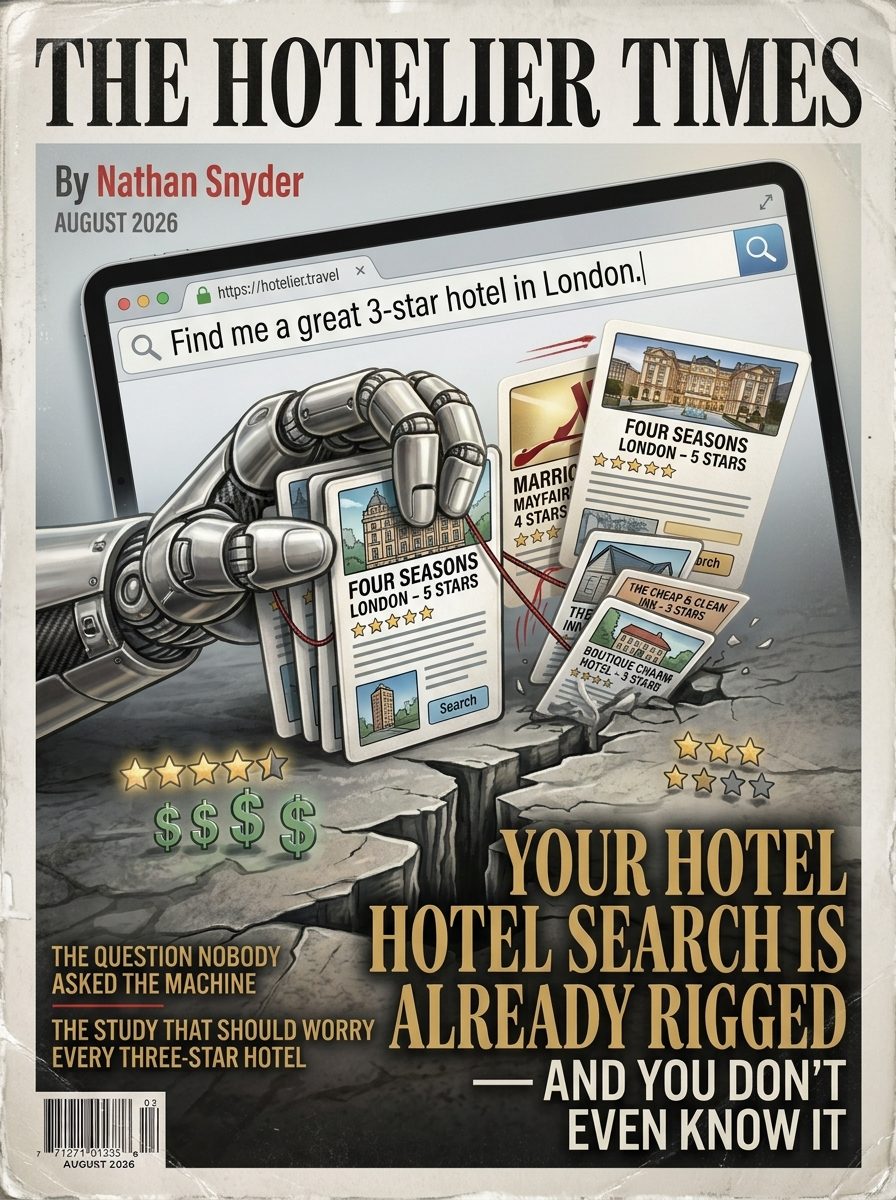
Ask an AI assistant to find you a hotel in a city you've never visited, and it will answer with the calm authority of something that has read everything and remembers all of it. That confidence is the problem. The thesis of this piece is simple and a little unsettling: the AI systems now steering an enormous share of hotel discovery are not neutral, are not ranking by quality, and are not even particularly good at their stated job — they are amplifying a narrow set of biases that most travelers, and most hotel owners, have no idea exist.
This isn't speculation. It's what happens when you actually measure the thing.
The Study That Should Worry Every Three-Star Hotel in America
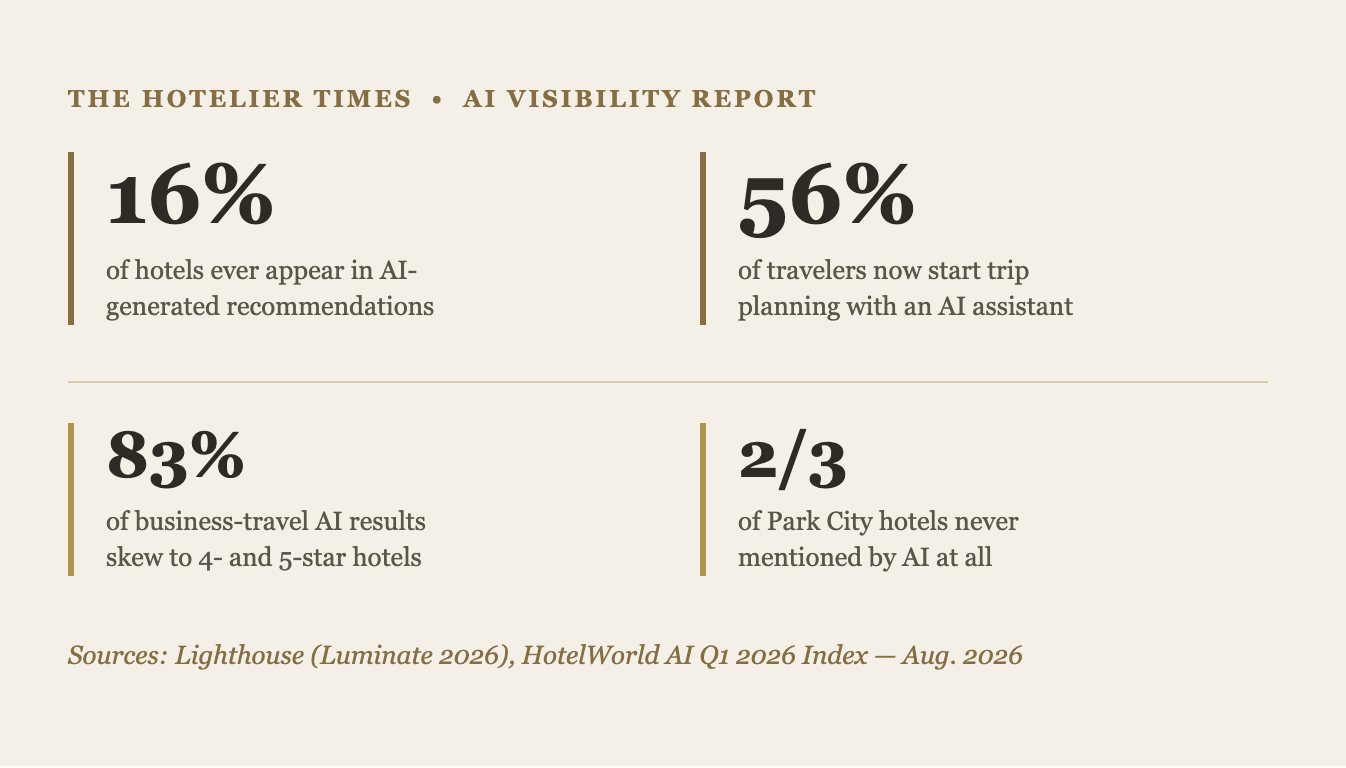
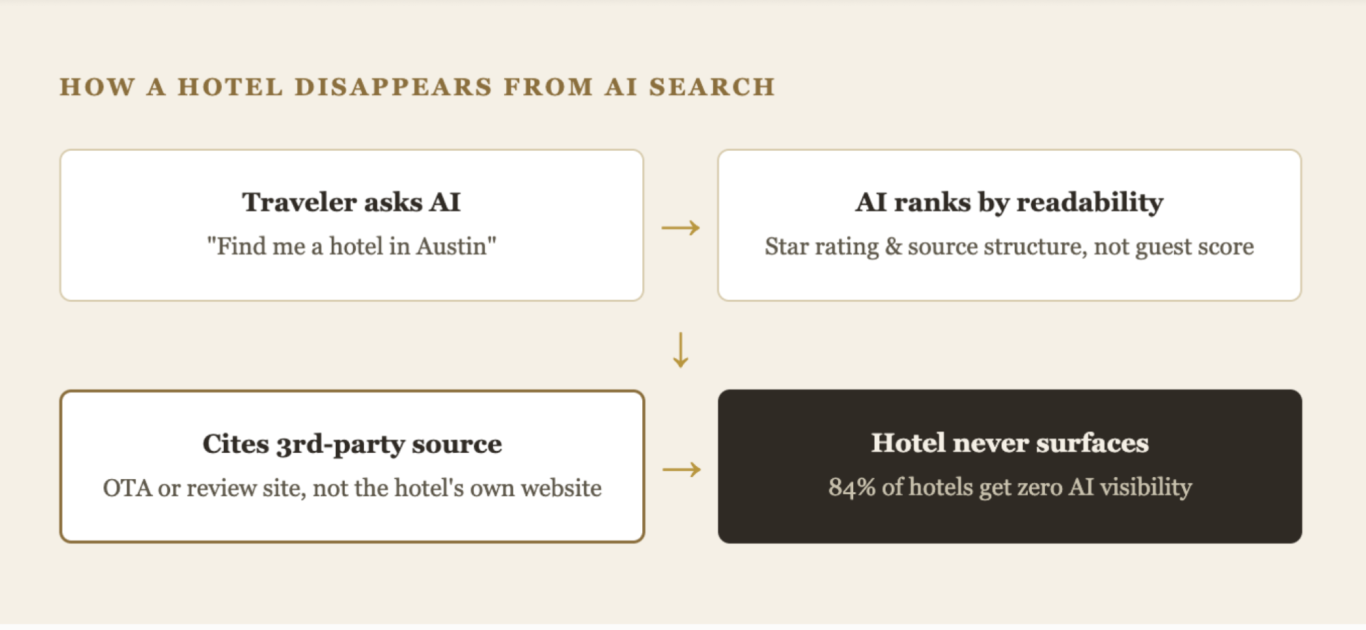
At Luminate 2026, the hospitality data firm Lighthouse presented research built on more than 4,500 ChatGPT prompts across nine global destinations and five traveler personas — one of the largest independent audits of AI hotel recommendations to date. The finding that should alarm anyone running a mid-tier property: a hotel's actual guest review score barely correlated with whether AI recommended it. What did correlate, overwhelmingly, was star rating. On completely generic prompts — travelers who gave no budget, no preference, nothing beyond "I need a hotel" — four- and five-star properties dominated the results, while three-star hotels were nearly absent. Business travel prompts skewed 83% toward four- and five-star recommendations, according to Lighthouse's presentation, despite the fact that a clean, well-run three-star property is entirely appropriate for the average business trip. In Park City specifically, two-thirds of hotels were never mentioned across the entire prompt set — not ranked low, simply invisible.
That word — invisible — turns out to be the operative one across nearly every independent study on this topic. HotelWorld AI's Q1 2026 Visibility Index, built on 2.36 million data points pulled from ChatGPT, Gemini, and Perplexity, found that only 16% of hotels appeared in AI-generated recommendations at all. A separate large-scale analysis by researcher Nicolas Sitter, covering more than 245,000 unique sources cited across nearly 20,000 AI runs, found that Marriott alone captured 39% of chain citations on one major model — with the exact skew shifting depending on which AI system you ask. Perplexity, the same research found, favors luxury brands like Four Seasons and Ritz-Carlton while nearly ignoring Hyatt. Ask a different AI, get a different — and similarly distorted — answer.
Why This Matters More Than Google Ever Did
Search engine optimization, for all its flaws, was at least a game with somewhat visible rules. AI visibility, according to industry researchers at RevPARGenius, operates on an entirely different and far less transparent set of signals — and the stakes are rising fast, with an estimated 56% of travelers now beginning trip planning with an AI assistant rather than a traditional search engine. A property can hold a 4.8-star rating and a first-page Google ranking and still be functionally invisible to more than half of prospective guests, simply because its website wasn't built in a way a language model finds easy to parse.
This is the mechanism behind an observation industry commentators have started making bluntly: AI does not begin with brand preference or guest satisfaction. It begins with retrievable evidence — the property with the broader, more consistent, machine-readable footprint wins, regardless of whether it's actually the better hotel. One widely discussed 2026 Skift analysis found that when AI was asked about a specific Hyatt property, the source it cited most wasn't Hyatt's own site. It was NerdWallet.
The Part the Industry Doesn't Want to Say Out Loud
For two years, hotel conferences have treated AI as a liberation technology — the tool that would finally let independent hotels escape the 15-to-25% commission tax that OTAs have extracted for two decades. The data increasingly suggests the opposite is happening. Booking.com and Expedia have already embedded AI across their own ranking and recommendation systems at a scale independent properties cannot match. Meanwhile, a July 2026 industry roundup noted that Radisson's ChatGPT integration, IHG's conversational search tool, and Google's new "Direct Offers" format were all announced with plenty of detail about capability — and not one of them named a commission rate for agentic bookings. The infrastructure for AI-driven booking is being built quickly. The question of who profits from it, and by how much, is being answered slowly and quietly, brand by brand.
Some hotel companies are responding by trying to own the layer directly rather than compete inside someone else's model — Marriott's "Ask Bonvoy" conversational search tool, launched for loyalty members, is one example of a brand trying to route AI-assisted discovery through its own system instead of a third party's. Amadeus, similarly, introduced an "AI Commerce" platform at HITEC 2026 aimed at making hotels bookable inside AI conversations through their own infrastructure. Whether these efforts meaningfully close the visibility gap for the average independent hotel, or simply give the largest brands another advantage the smaller operators can't afford to replicate, remains an open question — and arguably the more important one.
The Conclusion Worth Sitting With
The thesis bears repeating with the evidence now behind it: AI-driven hotel search is not a neutral upgrade to the way travelers find rooms. It's a new gatekeeper, operating on star-rating bias, source machine-readability, and per-platform quirks that have nothing to do with which hotel would actually serve a given traveler best — and it is already shaping bookings at scale, with only 16% of hotels earning any AI visibility at all. For travelers, this means the "unbiased AI recommendation" is, for now, considerably less unbiased than it sounds. For hotel owners — especially the three-star, independent, and boutique properties that the data shows are disappearing from these results entirely — the message is more urgent: the invisibility isn't a mystery to be solved later. It's happening in the current booking cycle, and the brands with the resources to fix it are already moving.
Sources
- Lighthouse / Hospitality Net, "The AI Recommendation Is the New Battleground for Hotel Distribution," June 2026 (Luminate 2026 presentation)
- HotelWorld AI Q1 2026 Visibility Index, cited via AgentPMT, "Hospitality AI Roundup: The Moves Around the Booking Race," June 2026
- Nicolas Sitter, "AI Hotel Landscape 2026: How ChatGPT, Gemini, Perplexity & Grok Recommend Hotels," June 2026
- RevPARGenius, "Hotel AI Visibility: 2026 Guide to ChatGPT Travel Search," June 2026
- Hospitality Net (opinion), "The Hotel Industry Has Been Waiting for AI to Save It From the OTAs," May 2026
- Hospitality Net, "Hotels Now Pay to Be Looked At," June 2026
- Hospitality Net, "HN Brief: Five Hotels Take Half of All AI Recommendations, Agentic Booking Has No Commission Answer," July 2026
- Hospitality Net (opinion), "Here's What Happens When AI Starts Making Decisions and Bookings for Hotel and Travel Guests," Aug. 2026 (citing Expedia Group 2026 AI Trust Gap research and Booking.com Global AI Sentiment Report)
- HotelRank.ai, "AI Hotel Research" (original citation analysis across ChatGPT, Gemini, Perplexity, Grok, Google AI Mode)