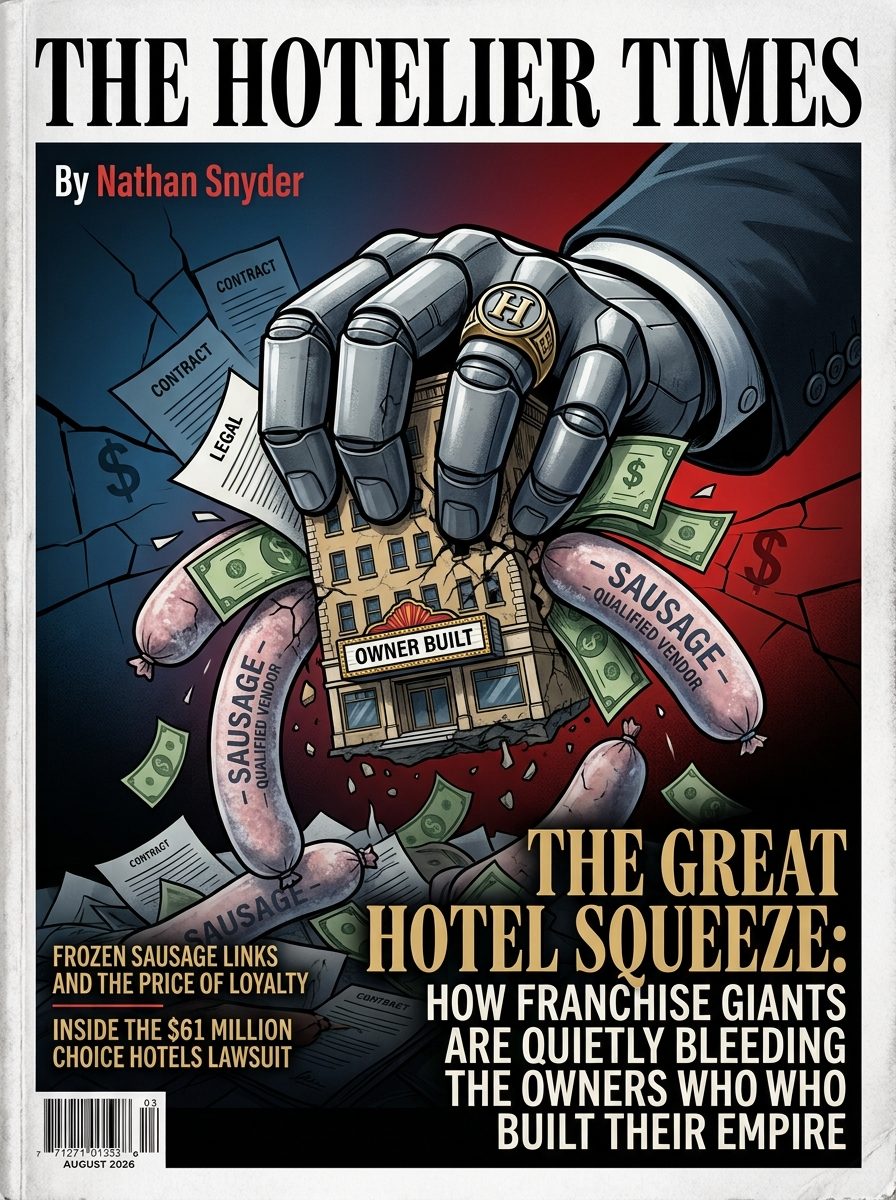
Frozen Sausage Links and the Price of Loyalty
There is a specific kind of insult that only a franchise agreement can deliver, and it arrives disguised as a grocery bill. Choice Hotels franchisees, according to a federal lawsuit, were required to pay $34.50 for ten pounds of frozen sausage links through the company's "qualified vendor" program — while operators outside that program paid $22.37 for the identical product. The difference wasn't inflation. It was, the suit alleges, a business model: vendors pay Choice an initial $25,000 fee to be "qualified," then quietly pass that cost back to the franchisees who have no real choice but to buy from them.
That's the thesis of this piece, stated plainly: the modern hotel franchise agreement has stopped functioning as a partnership between brand and owner and started functioning as an extraction mechanism, one where the franchisor's revenue grows in direct proportion to the franchisee's helplessness. What's happening between Choice Hotels, IHG, and their owners right now isn't a hotel industry story. It's a small-business story, and every entrepreneur who has ever signed a franchise agreement — for a hotel, a sandwich shop, a gym, a tax office — should be paying attention.
The Numbers Behind the Outrage
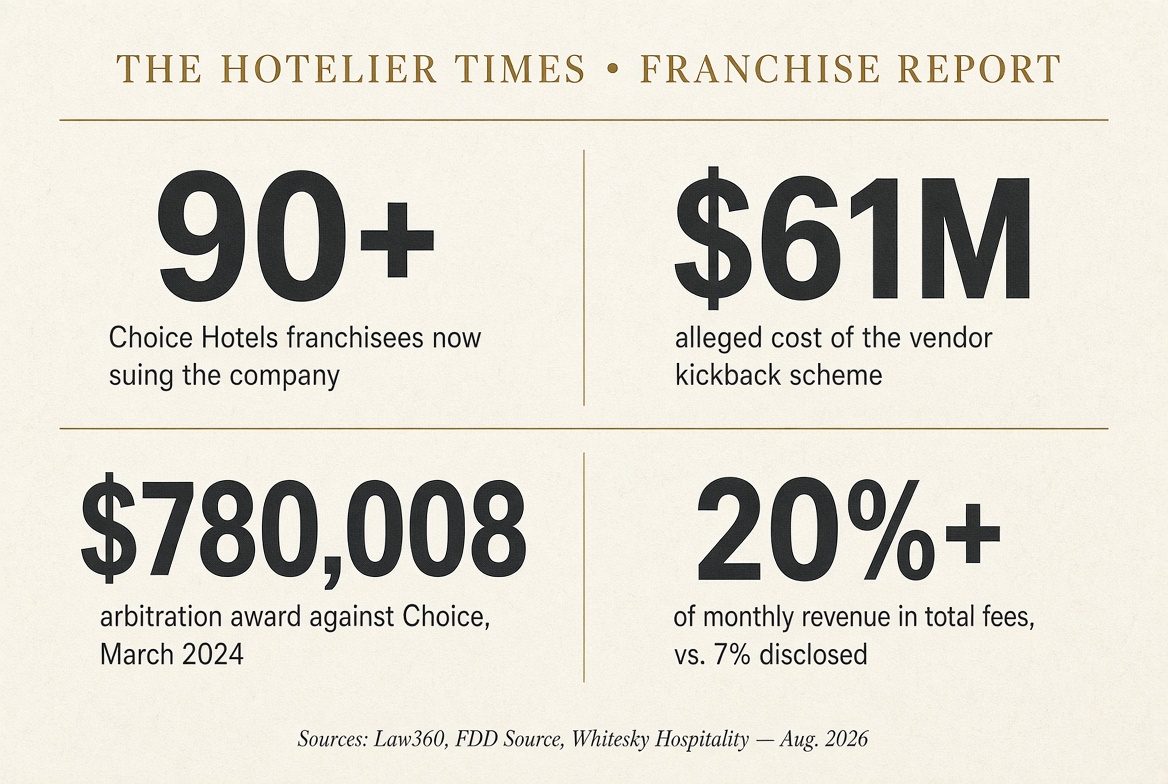
More than ninety Choice Hotels franchisees, many of them South Asian and Indian-American owners, have taken the company to federal court alleging vendor kickback schemes, price gouging, and discriminatory enforcement of franchise terms, according to reporting compiled by FDD Source and Law360. The suits claim the vendor kickback scheme alone cost franchisees an estimated $61 million. IHG is facing a parallel legal fight — a single 2021 suit filed in New Orleans that has since grown into at least five coordinated cases seeking class-action status.
These aren't vague grievances. The allegations, as detailed by industry legal analysis from Whitesky Hospitality, include Choice Privileges loyalty fees running as high as 5% of gross room revenue, undisclosed technology and cybersecurity charges never mentioned in the original franchise agreement, and total fees that reportedly reach more than 20% of monthly revenue against a disclosed figure closer to 7%. In March 2024, an arbitrator found Choice had in fact breached its contract in one case, ordering the company to pay $780,008 to a single franchisee group — a small number next to the alleged $61 million total, but a real ruling nonetheless, and one AAHOA has pointed to as validation of its long-standing complaints.
Both companies deny the core allegations. As of the most recent reporting, the cases remain scattered across arbitration, federal court, and appeal — a legal landscape built, critics argue, precisely to be scattered. Most hotel franchise agreements route disputes into mandatory arbitration on the franchisor's home turf, a structural advantage that makes a $61 million claim exhausting to pursue and easy for a company the size of Choice or IHG to simply outlast.
When the Trade Association Itself Gets Cut Off
If you want to understand how entrenched this dynamic has become, look at what happened when the industry's largest owner advocacy group tried to push back through entirely peaceful means. AAHOA — the Asian American Hotel Owners Association, representing more than 20,000 members who collectively own over 60% of U.S. hotels — maintains a set of standards called the "12 Points of Fair Franchising." Among them: full disclosure of vendor commissions and kickbacks, restrictions on forced vendor exclusivity, and a prohibition on charging fees that weren't disclosed in the original franchise agreement.
In the summer of 2022, Marriott International formally ended its relationship with AAHOA over these twelve points, stating in a letter obtained by Hotel Management that it "cannot support, either by endorsement and/or financially, any organization" whose positions run counter to its business model. Marriott specifically objected to AAHOA's support of a New Jersey bill that would have required franchisors to disclose vendor kickbacks and properly compensate owners when loyalty points were sold to guests. AAHOA's leadership said at the time that Marriott never specified which of the twelve points it actually found objectionable — only that the association's broader posture was, in Marriott's words, "anti-franchising."
Marriott quietly returned to AAHOA's annual convention roughly two years later without ever publicly clarifying what changed. What did change, in the interim, was AAHOA's own document: at its 2024 convention, the association added a new "Change of Control" clause recommendation, aimed at protecting franchisees when a brand gets acquired, sold, or merged — a direct response, the association said, to the wave of consolidation across Marriott, Wyndham, and Choice in recent years.
Why This Is Bigger Than Hotels
Here's the uncomfortable truth this story keeps circling back to: hotel owners are not a uniquely mistreated class of small business people. They're simply one of the better-organized ones, which is why their fight is visible at all. The same structural dynamics — vendor kickback arrangements, mandatory arbitration clauses that favor the larger party, fees layered on after the ink dries — exist across nearly every major franchise category in America. The Federal Trade Commission issued formal guidance in July 2024 warning against undisclosed franchise fees industry-wide, not hotel-specific guidance.
What makes the hotel fight worth watching is the scale of consolidation behind it. Franchise adoption is accelerating — in Europe, it now represents three-quarters of the hotel development pipeline, according to Whitesky Hospitality's market analysis — while the brands themselves have shifted decisively toward an "asset-light" model: they don't want to own hotels anymore. They want the fees. Jennifer Nellany, a franchise attorney speaking at the 2026 Hospitality Law Conference, put it bluntly: brands "certainly don't want to own" the properties bearing their name. They want the royalty stream, the loyalty program cut, and the vendor rebate — with none of the operational risk sitting with them.
The Conclusion the Data Points To
None of this means franchising itself is a scam, or that every hotel owner under a major flag is being cheated. Plenty of franchise relationships work exactly as intended, and brand affiliation still delivers real value in distribution and loyalty traffic that an independent property often can't replicate alone. But the pattern documented across ninety-plus Choice Hotels franchisees, a parallel IHG class action, an arbitrator's finding of breach of contract, and a trade association's very public excommunication for asking about vendor kickbacks — that pattern isn't noise. It's a signal that the balance of power in hotel franchising has tilted hard toward the franchisor, and the industry's own advocacy groups have run out of quiet ways to say so.
The thesis holds: the modern hotel franchise agreement increasingly functions less like a partnership and more like a toll booth, one where the franchisee bears the operational risk and the franchisor collects the fee regardless of outcome. Owners who are signing new agreements in 2026 — or renewing old ones — would do well to read the vendor rebate, technology mandate, and dispute resolution clauses with the same scrutiny they'd apply to a $61 million lawsuit, because for the ninety-plus owners now suing Choice Hotels, that's exactly what those clauses turned out to be.
Sources
- Whitesky Hospitality, "The Hotel Owner's Playbook: Navigating Franchise Agreements in a Consolidating Market," Jan. 2026
- FDD Source, "Hotel Franchise Lawsuits: What Indian American Owners Are Fighting and What It Means for You," May 2026
- Law360, "Choice Can Confirm Award Over $61M In Franchisee Claims," Mar. 6, 2024
- Law360, "Choice Hotels Franchisees Fight Arbitration For Kickback Suit," Aug. 13, 2020
- ValueXpress, "Choice Hotels Sued By Franchisees Over Vendor Programs and Fees," June 2020
- Asian Hospitality, "Choice Franchisees in Lawsuit Accuse Company of Racial Bias"
- Hotel Management, "Marriott to Disengage From AAHOA in Response to Fair Franchising Points," July 2022
- HOTELSMag.com, "AAHOA and Marriott International Impasse Still Aflame," Jan. 2023
- Hotel Management, "AAHOA Updates 12 Points of Fair Franchising in Wake of Acquisitions," Apr. 2024
- Asian Hospitality, "Marriott Executive Makes Appearance at AAHOACON24," Apr. 2024
- CoStar/Hospitality Net, "The Evolving Legal Landscape of Hotel Franchise Agreements," May 2026
- Minnesota Lawyer, "8th Circuit: Choice Hotels Didn't Breach Franchise Pact," July 2026
Editor's note: Choice Hotels and IHG have denied the core allegations described in this piece. Litigation in these cases remains ongoing as of publication.