August 13, 2026
Written By Topher Wilson
For years, the hospitality industry has been fighting a quiet war. It is not fought with armies or headlines. It is fought through booking platforms, guest reviews, loyalty programs, and the eternal question every traveler asks: Do I want a hotel, or do I want to feel like I’m living somewhere else?
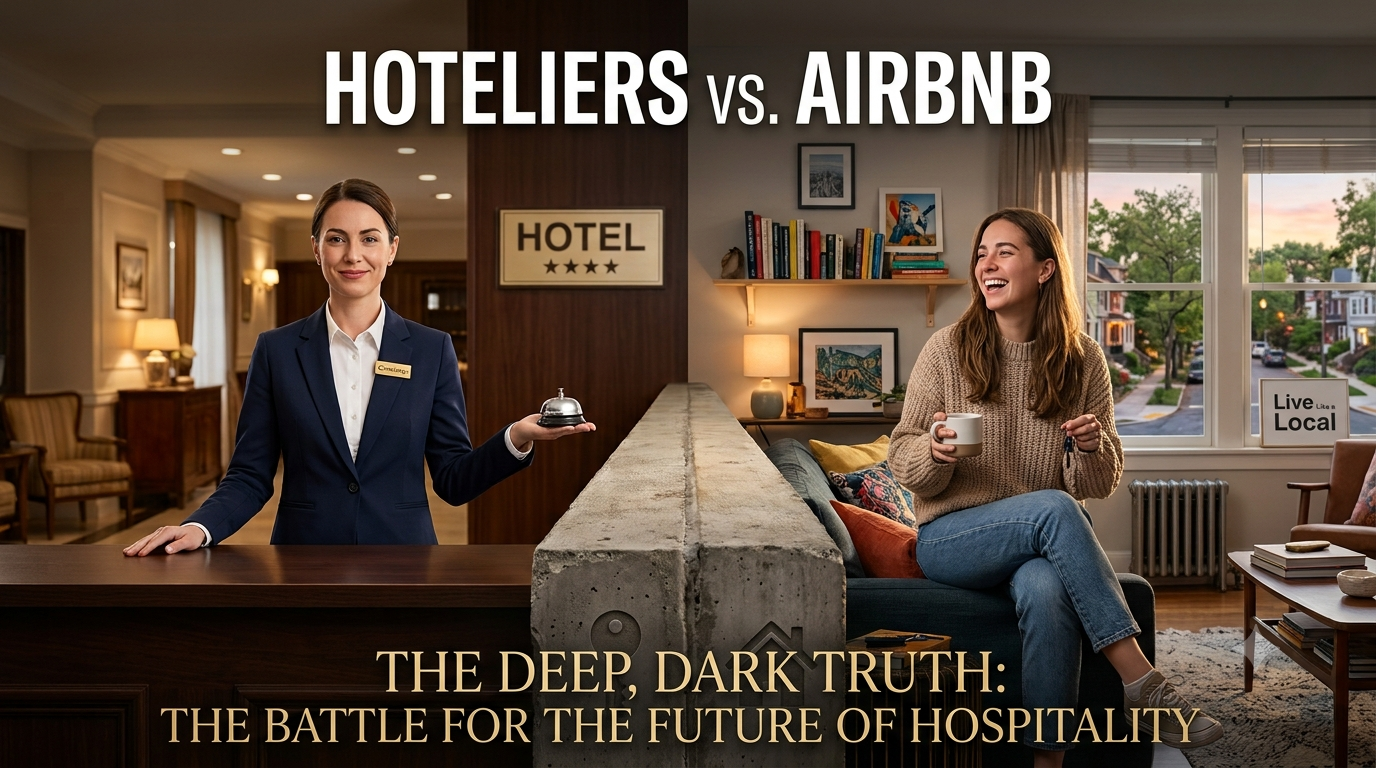
On one side are hoteliers — the traditional guardians of hospitality, trained in the art of service, consistency, and creating experiences at scale. On the other side is Airbnb, the disruptor that promised travelers something hotels struggled to sell: authenticity, space, and the feeling of belonging.
The deep, dark truth? The battle was never really about rooms. It was about what people believe hospitality should be.
The Hotel Industry’s Original Promise
Hotels were built around a simple idea: take care of people when they are away from home.
A good hotel was never just four walls and a bed. It was the person at the front desk who remembered your name, the housekeeper who noticed you needed extra towels before you asked, the concierge who somehow found a dinner reservation when every restaurant said “no.”
Hotels mastered something Airbnb initially could not: human orchestration.
Behind every seamless stay is a complicated machine — operations, maintenance, safety standards, trained employees, security, compliance, and thousands of invisible details guests rarely notice unless something goes wrong.
Hotels are essentially controlled chaos wearing a pressed suit.
Airbnb’s Great Disruption
Then came Airbnb.
Suddenly, travelers could sleep in a Parisian apartment, rent a beach house, or stay in a neighborhood instead of a tourist district. It challenged the idea that hospitality needed a lobby, a bell desk, and a uniform.
Airbnb didn’t just sell accommodation. It sold a story.
It told travelers: “Don’t visit a place. Live there.”
And that message was powerful.
The platform tapped into a growing desire for personalization. Travelers wanted kitchens instead of minibars, neighborhoods instead of business districts, and experiences instead of predictable stays.
For many people, hotels started to feel like airports: efficient, familiar, and sometimes emotionally distant.
But Here Is Where the Story Gets Complicated
The romantic idea of Airbnb began meeting the reality of running a hospitality business.
Not every host was a local sharing a spare bedroom. Many properties became professional short-term rentals managed by companies operating like hotels — except without the same regulations, staffing costs, or operational expectations.
Cities began debating housing shortages, neighborhood disruption, and the impact of turning residential properties into vacation inventory.
The “authentic local experience” became harder to define when the person handing you the keys lived three states away and communicated exclusively through automated messages.
The truth is, hospitality is difficult whether you call yourself a hotelier or a host.
The Hotelier Advantage: People
Hotels have something Airbnb can’t easily replicate: people working together to create a consistent experience.
A hotel is a living organism. It wakes up every morning.
The front desk team, housekeeping department, engineers, restaurant staff, managers, and countless others all contribute to a guest’s memory of a place.
When done well, a hotel becomes more than accommodation. It becomes part of the journey.
The best hotels understand that guests rarely remember the thread count of the sheets. They remember how they felt when they stayed there.
Airbnb’s Advantage: Freedom
But hotels cannot ignore what Airbnb changed.
Airbnb forced the industry to rethink flexibility, design, and personalization.
Guests became less interested in simply receiving a room. They wanted a sense of place.
The modern traveler wants options: a boutique hotel in the city center, a cabin in the woods, a design-forward apartment, or a unique property they can share online.
The future of travel is not hotels versus Airbnb.
It is hospitality versus irrelevance.
The Future Belongs to Those Who Adapt
The mistake hoteliers could make is fighting Airbnb by pretending it does not exist.
The lesson Airbnb taught the industry is valuable: people want experiences.
They want stories. They want connection. They want something worth remembering.
But Airbnb’s lesson from hotels is equally important: hospitality requires trust, professionalism, and attention to detail.
The future will not belong exclusively to hotels or short-term rentals.
It will belong to operators who understand that hospitality is not a building, a booking platform, or an algorithm.
It is a promise.
A promise that when someone arrives somewhere unfamiliar, someone — or something — is there to make them feel welcome.
And that, after all, is the oldest business in travel.